

The upcoming reduction in the qualifying period for unfair dismissal claims from two years to six months has understandably prompted many HR teams to focus on legal compliance. Organisations are reviewing employment contracts, updating policies and reconsidering probation procedures in anticipation of reforms expected to come into force in January 2027.
Those are sensible first steps. The more important question, however, is whether organisations are preparing their managers for a fundamentally different way of managing people.
Employment legislation can change overnight. Management habits rarely do. For many years, employers have benefited, whether consciously or otherwise, from having time on their side. Managers could observe a recruit over an extended period, address concerns gradually and decide – often over many months – whether an individual was the right fit for the organisation. The current two-year qualifying period has inevitably shaped management behaviour, even if few businesses would openly acknowledge it.
A six-month qualifying period changes that dynamic considerably. It leaves far less room for delayed conversations, informal arrangements and assumptions that concerns can always be addressed later. Recruitment decisions, induction, objective setting and probation reviews all become more significant because there is less opportunity to recover from a poor start. The instinctive response is to revise documentation. Updated policies are, of course, essential, but they are unlikely to be where the greatest risk lies.
Over many years of advising employers, one pattern has repeated itself with striking consistency. Organisations rarely find themselves defending difficult employment decisions because their policies were inadequate. More often, the policies are perfectly sound. The difficulty is that what happened bears little resemblance to the process those policies describe. Probation meetings are postponed because operational priorities intervene. Feedback is delivered informally but never recorded. Expectations remain unclear because managers avoid difficult conversations in the hope that performance will improve naturally. HR is frequently brought into the process only once the employment relationship has already begun to unravel.
By that stage, opportunities to influence the outcome constructively may already have been lost. That is why the forthcoming reforms should prompt HR leaders to ask a different question. Rather than asking whether their policies are compliant, they should ask whether their managers have the confidence, capability and support to apply those policies consistently. The answer may be rather less reassuring.
Many line managers have never been trained to view probation as a structured management process. It is often treated as an administrative deadline rather than a period during which expectations are established, feedback is given, support is provided and performance is actively managed. That approach has always carried organisational risks. Under the new framework, those risks are likely to become far more apparent.
This is not an argument for making dismissal decisions more quickly. Quite the opposite. Earlier conversations, clearer objectives and regular feedback give employees a greater opportunity to succeed. Effective probation management is as much about helping people perform well as it is about identifying when an appointment is unlikely to succeed. Organisations that invest in management capability are therefore likely to improve employee engagement and retention, as well as reduce employment disputes.
Too many organisations continue to regard employment law as something to consult only when relationships begin to break down. Increasingly, the greatest value comes much earlier. One of the biggest misconceptions I encounter is that employment lawyers add the greatest value when dismissal is being contemplated. The conversations that most influence legal risk often take place months beforehand, when probation processes are being designed, managers are being trained or early performance concerns first emerge. By the time an organisation is asking whether it can dismiss fairly, the quality of the evidence has often already been shaped by decisions made long before legal advice was sought.
The reduction in the qualifying period should therefore be viewed as more than another employment law reform requiring updated documentation. It is an opportunity for organisations to examine whether their management capability has kept pace with the expectations now being placed upon it. The businesses that adapt most successfully are unlikely to be those with the longest policies or the largest HR teams. They will be those whose managers are equipped to have better conversations earlier, address problems consistently and apply fair processes with confidence from the outset of the employment relationship.
In my experience, organisations that invest in getting those fundamentals right rarely do so simply to reduce legal risk. They become better employers in the process.
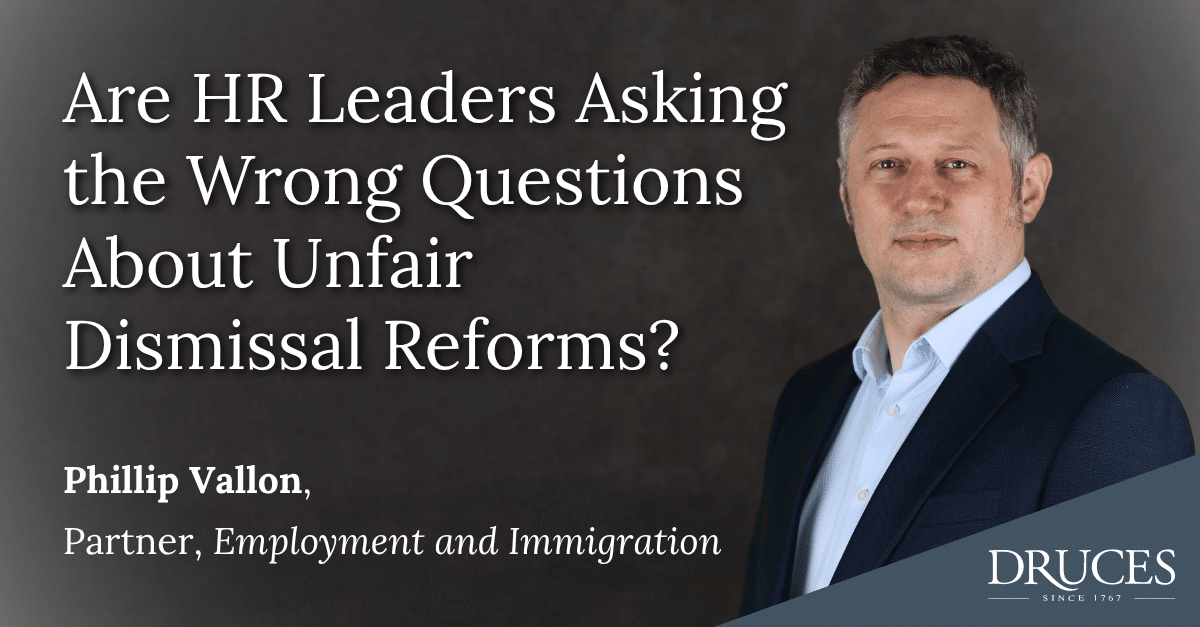
Phillip Vallon, Partner, Employment & Immigration Law at Druces.
To speak with Phillip Vallon, contact him at p.vallon@druces.com or call +44 (0)20 7216 5568.
For more information on employment advice, click here.
Article originally published on: People Management, July 24th 2026


