

Sadly sometimes, for directors, the decision to close a company can be a responsible one. It can limit losses to creditors and reduce the risk of personal liability associated with wrongful trading. However, the decision to move toward closure rather than rescue is complex and highly fact specific. Without early legal input, directors may default to closure prematurely – or, conversely, delay too long and exacerbate liabilities and run the risk of exposing themselves to personal liability.
Directors are understandably cautious in the current climate, but with the right advice at the right time, there are often more options available than businesses initially assume.
This is where closer, ongoing relationships with legal advisers become critical. Regular dialogue allows directors to test assumptions, explore restructuring tools such as CVAs or administrations, and understand the implications of each route. It also ensures that decisions that are taken by the board are informed, properly documented and defensible, which is essential if they are later scrutinised.
Directors of hospitality businesses face particular challenges: fluctuating demand, high fixed costs, and exposure to external shocks. In this environment, governance cannot be an afterthought. Legal advisers can support boards in establishing robust decision making systems that assist them in identifying early signs of stress and enable them to react and adapt quickly.
Lawyers can also guide directors on their shifting duties as insolvency risk increases. Once a company approaches insolvency, the focus moves from shareholders to creditors. Decisions must be taken with creditor interests in mind, and missteps can lead to personal liability or disqualification.
Engaging lawyers early enables directors to navigate this transition with confidence. It also opens a broader range of options. For example, a well-timed restructuring may preserve jobs, maintain supplier relationships, and retain brand value – outcomes that are far harder to achieve once a business has reached the brink.
The cumulative effect of the stress that the hospitality industry is experiencing is already visible on the UK high street. Restaurant closures leave gaps that are not always quickly filled. This has knock-on effects for footfall, employment, and local economies.
At the same time, the sector is not simply shrinking; it is evolving. Operators are experimenting with new formats, delivery models, and cost structures. Those that succeed are often the ones that have taken decisive action, early supported by advisers who understand both the legal framework and the commercial realities of hospitality.
Ultimately, the issue is one of mindset. Legal advisers should not be viewed solely as a last line of defence, but as strategic partners in navigating an increasingly complex landscape. Building that relationship before a crisis allows for better planning, more options, and stronger outcomes.
The businesses that come through this period strongest will be those that plan early, act decisively and seek advice before they need it – not after the fact.
For hospitality businesses facing uncertainty, the message is clear: don’t wait until the fire has started to look for the extinguisher. The earlier you involve your legal team, the more likely you are to avoid the fire altogether – or at least contain it on your own terms.
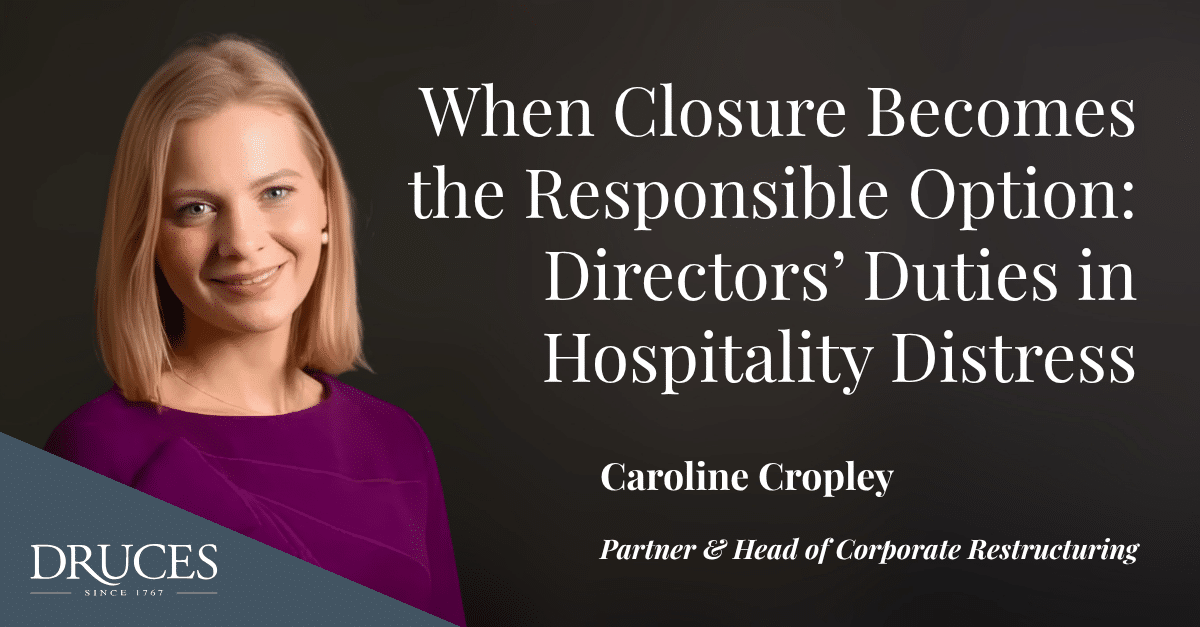
Caroline Cropley, Partner & Head of Corporate Restructuring at Druces LLP
To speak with Caroline Cropley about your business, contact her at c.cropley@druces.com or call +44 (0)20 7216 5551.
For more information on corporate restructuring, click here.


